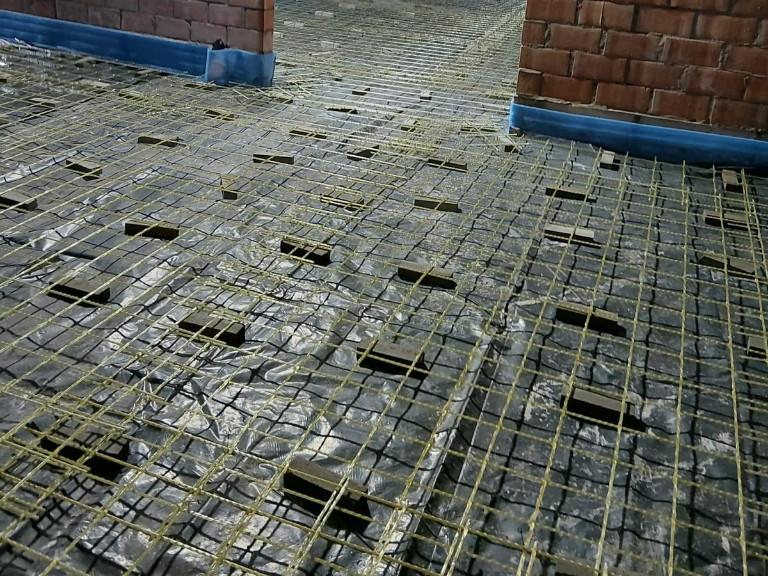
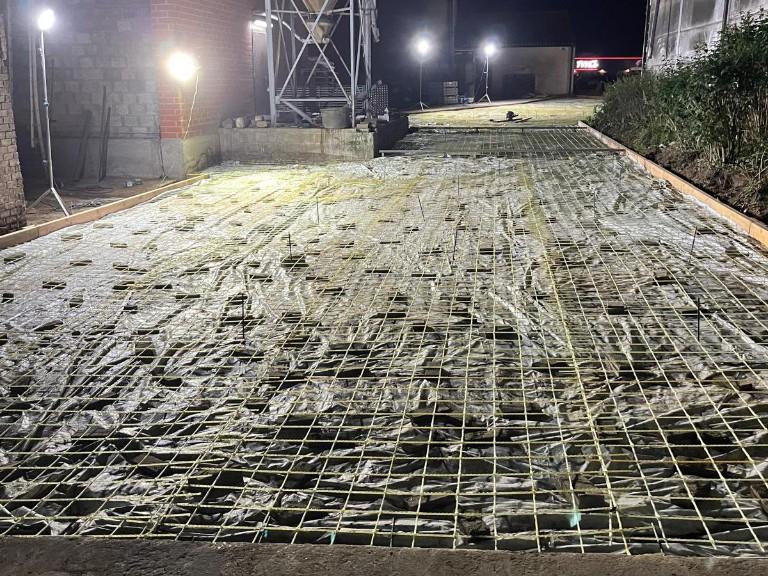
FRP reinforcement for swimming pools
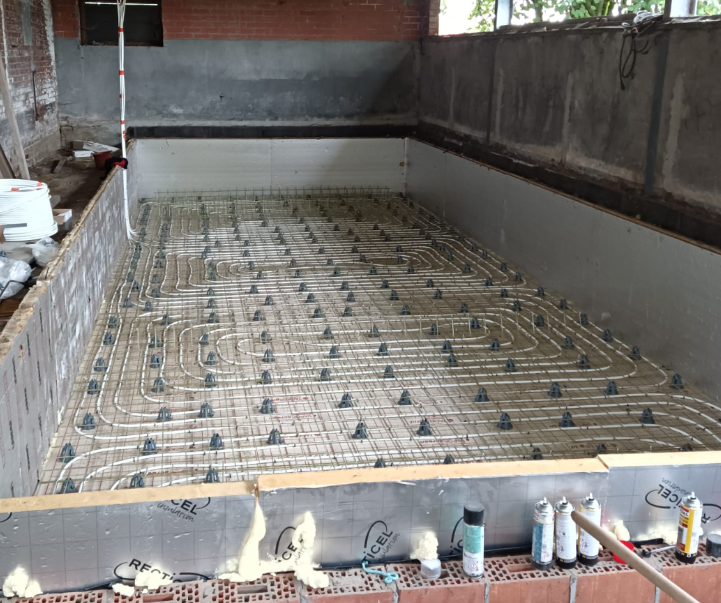
GFRP reinforcement in swimming pools: no corrosion from chlorinated water, no rust stains, lighter to place, and electrically non-conductive around pumps and lighting.
A swimming-pool basin stays wet for decades, with chlorinated water on one face and damp soil or plant rooms on the other. Steel reinforcement can corrode in that chloride-rich, permanently moist environment. GFRP does not: it is non-corrosive, which is the main reason to specify it in pool walls and floor slabs.
Because the bars and meshes do not rust, you also avoid rust stains and the concrete spalling that follows corroding steel. Tightness and appearance both matter on a pool: a stain or a crack from rust expansion is expensive to repair once the basin is in service.
Weight helps on site. GFRP is much lighter than steel — a typical property of the material, and one ACI highlights for FRP reinforcement. Crews carry, place and tie the mesh by hand, which is useful in a deep basin where every lift has to come over the wall.
FRP is electrically non-conductive. Around pool lighting, pumps, bonding and other electrical work that is an extra safety and detailing advantage: the reinforcement itself is not a conductor in the wet structure. It is also non-magnetic. That is rarely the main argument on a pool, but it is a standard property of FRP.
Tensile strength is high relative to self-weight, so the same structural job can be done with a lighter grid. In a permanently wet, chloride-bearing environment that also points to a longer service life and less corrosion-driven maintenance.
Cover can often be tighter from a corrosion point of view, because you are no longer protecting steel against rust. Effective cover must still be set for structure and to the applicable standard — you only drop the extra millimetres that steel would have needed as a rust barrier.
Lightweight. Corrosion-free. Built for wet concrete.